XYM Occupational Safety and Health Policy
In Xymbolic, we recognize and accept its health and safety duties for providing a safe and healthy working environment (as far as is reasonably practicable) for all its workers (paid or volunteer) and other visitors to its premises under Republic Act (RA) 11058.
REPUBLIC ACT NO. 11058
An Act Strengthening Compliance with Occupational Safety and Health Standards and Providing Penalties for Violations Thereof
This Act aims to ensure the rights of workers against occupational hazards resulting in injury, sickness, or death. Covered workplaces shall establish an Occupational Safety and Health (OSH) program.
OSH Purpose
To take all reasonably practicable steps to safeguard the health, safety, and welfare of all personnel on the premises.
To provide adequate working conditions with proper facilities to safeguard the health and safety of personnel and to ensure that any work that is undertaken produces no unnecessary risk to health or safety.
To encourage persons on the premises to cooperate with the organization in all safety matters, in the identification of hazards that may exist, and in the reporting of any condition that may appear dangerous or unsatisfactory.
To provide sufficient information, instruction, training, and supervision to enable everyone to avoid hazards and contribute to their own safety and health.
To make, as reasonably practicable, safe arrangements for protection against any risk to the health and safety of the general public or other persons that may arise from the group's or organization's activities.
To make a suitable and sufficient assessment of the risks to the health and safety of employees and of persons not in the employment of the group or organization arising out of or in connection with the group or organization’s activities.
To provide information to other employers about any risks to which those employers’s workers on the group's or organization’s premises may be exposed.
Duties of Employer
Employer Responsibilities:
- Responsible for providing workers with safe and healthy working conditions and a place that is free from hazardous conditions that can cause physical harm, illness, and death.
- Protect workers from violence, discrimination, and harassment.
- Familiarize his workers with their work environment, hazards, and steps to be taken in case of emergencies.
Safety Committee has a Duty to:
- Regularly inspect the workplace;
- Assist with accident investigations;
- Deal with the health and safety concerns of associates;
- Investigate refusals to work;
Duties of Worker
Your Responsibilities:
- Protect your own health and safety and that of your co-workers.
- Not initiate or participate in the harassment of another worker and cooperate with your supervisor and anyone else.
- Reports unsafe conditions and practices to the supervisor by making suggestions for the correction or removal of accident hazards.
- Cooperate actively with the Health and Safety Committee.
Your Rights:
- The right to know the hazards at work and how to control them;
- The right to participate in occupational health and safety; and
- The right to refuse work that you believe to be unusually dangerous.
The Act requires your employer to provide you with all the information you need to control the hazards you face at work. If you are inexperienced, you must receive an orientation that includes:
- What to do in a fire or other emergency;
- First aid facilities;
- Prohibited or restricted areas;
- workplace hazards; and
- any other information you should know.
You have the right to become involved in occupational health and safety. The Act encourages employers and workers to work together to maintain a healthy and safe workplace.
You have the right to refuse to do work that you believe is unusually dangerous. The unusual danger may be to you or to anyone else. An unusual danger could include such things as:
- a danger that is not normal for your occupation or the job;
- a danger under which you would not normally carry out your job; and/or
- a situation for which you are not properly trained, equipped, or experienced.
To exercise this right, use the following guidelines:
- Once you believe that the work you have been asked to do is unusual or dangerous, you should inform your supervisor.
- Make sure that the supervisor understands that you are refusing to do the disputed job for health and safety reasons.
- Work with the supervisor to attempt to resolve the problem.
If the problem cannot be resolved by the supervisor to your satisfaction, you may contact the safety officer. You also have the right to contact Human Resources at any time.
Do not leave the site without the permission of your employer.
Your supervisor should contact the safety officer and ask them to investigate. They will try to resolve the matter. If they cannot resolve the matter to your satisfaction, they will convene the Occupation Health and Safety Committee for an emergency meeting. The committee will investigate and prepare a report on the refusal.You have the right to continue to refuse until:
- Measures have been taken to satisfy you that the job is now safe to perform; or
- Your Occupation Health and Safety Committee has investigated and ruled against your refusal.
If you disagree with the decision of the committee, you may appeal to Human Resources.
An employer cannot assign another worker to do the disputed job unless the replacement worker is advised in writing:
- of the refusal and the reasons for it;
- of the reasons why the employer believes that the replacement worker can do the disputed job safely;
- that the replacement worker also has the right to refuse; and
- of the steps to follow when exercising this right.
Safety Officer
The safety officer is accountable to Human Resources and is responsible for occupational health and safety performance for all associates in their region at all levels. The safety officer must provide leadership in all aspects of health and safety activities at work or otherwise. The safety officer must take an active role in all aspects of safety within their region.
Duties
- Ensure that all reasonable steps are taken to prevent accidents.
- Be familiar with the Occupational Health and Safety Act, the company policy, and any other act pertaining to health or safety.
- Ensure all policies and acts are followed by all levels of associates.
- Ensure safety meetings are held and minutes are recorded, posted, and filed. according to occupational health and safety regulations.
- Ensure all accidents are reported and investigated.
- Ensure SDS (Safety Document Sheets) are provided for all hazardous materials. delivered to the workplace and are readily available for associates to review.
- Ensure associates are instructed in the procedures and requirements of occupational health and safety.
- Review all accidents and near misses to determine the root and basic causes, with suggestions for implementation of changes to prevent reoccurrence.
- All accidents, injuries, or near misses, regardless of their nature, shall be promptly reported to the safety officer.
- Clothing shall be appropriate to the duties being performed.
- Running is not permitted except in extreme emergencies.
- Visitors and customers are to be escorted by staff while on company property.
- Hand tools are to be used for their intended purpose only.
- Horseplay, fighting, or tomfoolery is strictly prohibited on premises.
- All spills will be immediately cleaned up and reported.
- Drawers and filing cabinets will be kept closed when not in use.
- Filing cabinet drawers are to be filled from the bottom up, or the cabinet is to be securely fastened or anchored.
- If you are not sure, ask.
- Follow instructions and don’t take chances.
- Wear your personal safety equipment.
- Never operate equipment you have not been trained for.
- Keep your work area clean.
- Avoid injury by lifting correctly. Max weight to be lifted by one person is 75lbs.
- Make sure the job can be done safely.
- Portable ladders must be secured against movement and placed on a stable base; the base of an inclined portable ladder is to be no further from the base of the wall or structure than ¼ of the height to where the ladder contacts the wall or structure.
- Purpose
- The purpose of this policy is to ensure all workplace accidents are promptly investigated to determine root causes, prevent recurrence, and maintain compliance with occupational health and safety regulations.
- Scope
- This policy applies to:
- All employees, contractors, and visitors.
- All incidents occurring on company premises or during work-related activities.
- Objectives
- Identify the cause(s) of accidents and near-misses.
- Recommend corrective and preventive actions.
- Maintain accurate records for regulatory compliance and continuous improvement.
- Responsibilities
- Supervisors/Managers: Report accidents immediately and secure the scene.
- Safety Officer: Lead the investigation, document findings, and recommend actions.
- Employees: Cooperate fully during investigations and provide accurate information.
- Reporting Procedure
- All accidents must be reported immediately to the supervisor and Safety Officer.
- Complete an Accident Report Form within 24 hours of the incident.
- Investigation Process
- Step 1: Secure the accident scene to prevent further harm.
- Step 2: Collect evidence (photos, equipment condition, environmental factors).
- Step 3: Interview witnesses and involved personnel.
- Step 4: Analyze root causes using methods such as the 5 Whys or Fishbone Diagram.
- Step 5: Document findings and corrective actions in an official report.
- Corrective Actions
- Implement measures to eliminate hazards.
- Update safety protocols and provide additional training if necessary.
- Monitor effectiveness of corrective actions.
- Documentation and Recordkeeping
- Maintain all investigation reports for a minimum of 5 years.
- Submit reports to regulatory authorities as required by law.
- Confidentiality
- All investigation details will be kept confidential and shared only with authorized personnel.
- All investigation details will be kept confidential and shared only with authorized personnel.
- Policy Review
- This policy will be reviewed annually or after any major incident to ensure effectiveness and compliance.
- This policy will be reviewed annually or after any major incident to ensure effectiveness and compliance.
- Purpose
-
This policy ensures that all workplace hazards are identified, communicated, and controlled through proper warning signs and preventive measures to protect employees’ health and safety.
-
This policy ensures that all workplace hazards are identified, communicated, and controlled through proper warning signs and preventive measures to protect employees’ health and safety.
- Scope
- Applies to:
- All employees, contractors, and visitors.
- All company premises and work-related activities.
- Objectives
- Identify and classify occupational hazards.
- Implement standardized warning signs for hazard communication.
- Ensure compliance with occupational health and safety regulations.
- Responsibilities
- Management: Provide resources for hazard identification and signage.
- Safety Officer: Conduct hazard assessments and ensure proper signage placement.
- Employees: Follow safety instructions and report missing or damaged signs.
- Types of Occupational Hazards
- Physical Hazards: Noise, heat, radiation, moving machinery.
- Chemical Hazards: Toxic substances, fumes, dust.
- Biological Hazards: Viruses, bacteria, mold.
- Ergonomic Hazards: Poor workstation design, repetitive strain.
- Psychosocial Hazards: Stress, harassment, fatigue.
- Warning Signs Standards
- Use internationally recognized symbols and color codes:
- Red: Fire hazards, emergency stop.
- Yellow: Caution for physical hazards.
- Blue: Mandatory actions (e.g., PPE required).
- Green: Safety equipment and exits.
- Signs must be:
- Visible and legible from a safe distance.
- Maintained and replaced when damaged or faded.
- Use internationally recognized symbols and color codes:
- Hazard Communication
- Post warning signs at all hazard-prone areas.
- Include clear instructions for safe practices.
- Provide training on hazard recognition and sign meanings.
- Monitoring and Review
- Conduct regular inspections to ensure signage compliance.
- Update hazard signs when processes or risks change.
- Policy Review
- This policy will be reviewed annually and updated as necessary to ensure compliance with applicable laws and best practices.
- Purpose
- This policy outlines the organization’s commitment to identifying, managing, and minimizing physical hazards in the workplace to prevent injuries and ensure compliance with occupational health and safety standards.
- Scope
-
Applies to all employees, contractors, and visitors across all work locations, including remote and field operations.
-
Applies to all employees, contractors, and visitors across all work locations, including remote and field operations.
- Definitions
- Physical Hazard: Environmental factors that can harm the body without direct contact, such as noise, vibration, radiation, extreme temperatures, and poor lighting.
- Incident: Any event that results in or could result in injury or damage.
- Policy Statement
- The organization is committed to:
- Providing a safe work environment free from physical hazards.
- Conducting regular inspections and risk assessments.
- Implementing engineering and administrative controls to reduce risks.
- Training employees on hazard recognition and safe practices.
- Responsibilities
- Management: Ensure compliance, allocate resources, and enforce safety standards.
- Supervisors: Monitor work areas and address hazards promptly.
- Employees: Follow safety guidelines and report hazards immediately.
- Common Physical Hazards and Controls
- Hazards - Control Measures
- Noise - Hearing protection, soundproofing
- Vibration - Anti-vibration gloves, equipment maintenance
- Radiation - Shielding, monitoring devices
- Extreme Temperatures - PPE, ventilation, hydration
- Poor Lighting - Adequate illumination, regular checks
- Risk Management Approach
- Conduct physical hazard assessments regularly.
- Apply hierarchy of controls (eliminate, substitute, engineering, administrative, PPE).
- Review controls after incidents or changes in operations.
- Training and Awareness
- Mandatory safety training during onboarding.
- Annual refresher courses and toolbox talks.
- Emergency Procedures
- Immediate reporting of incidents.
- First aid and emergency response protocols in place.
- Incident investigation and corrective actions.
- Review & Continuous Improvement
- Policy reviewed every 2 years or after major incidents.
- Employee feedback incorporated into improvements.
- Policy Review
- This policy will be reviewed annually and updated as necessary to ensure compliance with applicable laws and best practices.
- Purpose
-
This policy ensures the safe use, maintenance, and management of electrical systems and equipment to prevent electrical hazards, injuries, and property damage.
-
This policy ensures the safe use, maintenance, and management of electrical systems and equipment to prevent electrical hazards, injuries, and property damage.
- Scope
-
Applies to all employees, contractors, and visitors who work with or near electrical installations, equipment, or wiring within company premises.
-
Applies to all employees, contractors, and visitors who work with or near electrical installations, equipment, or wiring within company premises.
- Definitions
- Electrical Hazard: A dangerous condition where a worker could make electrical contact, resulting in shock, burns, or fire.
- Qualified Person: An individual trained and authorized to work on electrical systems.
- Policy Statement
- The organization is committed to:
- Complying with all relevant electrical safety standards and regulations.
- Providing safe electrical installations and equipment.
- Ensuring employees receive proper training and personal protective equipment (PPE).
- Implementing preventive maintenance and inspection programs.
- Responsibilities
- Management: Ensure compliance, allocate resources, and enforce safety standards.
- Supervisors: Monitor electrical work and ensure adherence to safety procedures.
- Employees: Follow safety guidelines and report hazards immediately.
- Electrical Safety Requirements
- All electrical work must be performed by qualified personnel.
- Lockout/Tagout procedures must be followed during maintenance.
- Use of insulated tools and PPE is mandatory.
- Damaged cords, plugs, or equipment must be reported and removed from service.
- No unauthorized modifications to electrical systems.
- Common Electrical Hazards and Controls
- Hazard - Control Measures
- Electric shock - Grounding, insulation, PPE
- Arc flash - Arc-rated clothing, safe distance
- Overload circuits - Regular inspections, circuit breakers
- Wet conditions - Use GFCIs, keep equipment dry
- Emergency Procedures
- Disconnect power immediately in case of an incident.
- Administer first aid and call emergency services.
- Report all electrical incidents to the safety officer.
- Training and Awareness
- Mandatory electrical safety training for all relevant staff.
- Annual refresher courses and toolbox talks.
- Review and Continous Improvement
- Policy reviewed every 2 years or after major incidents.
- Feedback from employees incorporated into improvements.
- Policy Review
- This policy will be reviewed annually and updated as necessary to ensure compliance with applicable laws and best practices.
- Purpose
-
This policy outlines the organization’s commitment to identifying, managing, and minimizing psychosocial hazards in the workplace to protect mental health and well-being. It aligns with ISO 45003 guidelines and applicable occupational health and safety laws.
-
This policy outlines the organization’s commitment to identifying, managing, and minimizing psychosocial hazards in the workplace to protect mental health and well-being. It aligns with ISO 45003 guidelines and applicable occupational health and safety laws.
- Scope
-
Applies to all employees, contractors, volunteers, and visitors across all work locations and remote work arrangements.
-
Applies to all employees, contractors, volunteers, and visitors across all work locations and remote work arrangements.
- Definitions
- Psychosocial Hazard: Any workplace factor that may cause psychological or physical harm, including job demands, low job control, poor support, bullying, harassment, and poorly managed organizational change.
- Psychological Health: A state of well-being where individuals can cope with normal stresses, work productively, and contribute to their community.
- Policy Statement
- The organization is committed to:
- Designing work to minimize psychosocial risks.
- Providing a safe and supportive environment that promotes mental health.
- Implementing evidence-based controls and trauma-informed practices.
- Ensuring confidentiality and access to support services (e.g., Employee Assistance Program).
- Responsibilities
- Executive Leadership: Provide resources, strategic oversight, and ensure compliance.
- Managers & Supervisors: Identify hazards, consult workers, and implement controls.
- Employees: Report hazards and participate in risk assessments.
- Risk Management Approach
- Conduct regular psychosocial risk assessments.
- Apply the hierarchy of controls (eliminate, substitute, engineering, administrative, PPE).
- Monitor and review controls after incidents or organizational changes.
- Common Pyschosocial Hazards and Controls
- Hazard - Control Measures
- High job demands - Workload balancing, realistic deadlines
- Low job control - Workload balancing, realistic deadlines
- Poor Support - Regular check-ins, mentoring
- Bullyin/Harassment - Regular check-ins, mentoring
- Poor change management - Regular check-ins, mentoring
- Reporting and Support
- All reports will be treated confidentially.
- Employees will have access to counseling and mental health resources.
- Review and Continuous Improvements
- Policy reviewed every 2 years or after significant incidents.
- Feedback from employees will inform improvements.
- Policy Review
- This policy will be reviewed annually and updated as necessary to ensure compliance with applicable laws and best practices.
-
Purpose
This policy aims to maintain a safe, healthy, and productive work environment by prohibiting the use, possession, distribution, or influence of alcohol and illegal drugs in the workplace. - Scope
This policy applies to all employees, contractors, and visitors on company premises or while conducting company business off-site. - Policy Statement
- The company strictly prohibits:
- Possession, use, or distribution of alcohol or illegal drugs on company property.
- Reporting to work under the influence of alcohol, illegal drugs, or misused prescription medication.
- Employees must comply with all applicable laws regarding controlled substances.
- The company strictly prohibits:
- Prescription and Over-the-Counter Medications
- Employees using prescribed or over-the-counter medications that may impair performance must inform their supervisor or HR confidentially.
- Misuse of prescription drugs is treated as a violation of this policy.
- Testing and Enforcement
- The company reserves the right to conduct drug and alcohol testing:
- Pre-employment
- Random testing
- Post-incident or reasonable suspicion
- Violations may result in disciplinary action, up to and including termination.
- The company reserves the right to conduct drug and alcohol testing:
- Employee Assistance
- The company encourages employees with substance abuse issues to seek help.
- Employee Assistance Programs (EAP) or referrals to rehabilitation services may be provided.
- Policy Review
- This policy will be reviewed annually and updated as necessary to ensure compliance with applicable laws and best practices.
- This policy will be reviewed annually and updated as necessary to ensure compliance with applicable laws and best practices.
- Purpose
- This policy aims to maintain a safe, respectful, and inclusive workplace by preventing and addressing sexual harassment. The organization is committed to providing an environment free from harassment, discrimination, and retaliation.
- This policy aims to maintain a safe, respectful, and inclusive workplace by preventing and addressing sexual harassment. The organization is committed to providing an environment free from harassment, discrimination, and retaliation.
- Scope
- This policy applies to;
- All employees, contractors, interns, and volunteers.
- All work-related settings, including offices, remote work environments, business trips, events, and online communications.
- Definition of Sexual Harassment
- Sexual harassment includes any unwelcome sexual advances, requests for sexual favors, or other verbal, non-verbal, or physical conduct of a sexual nature that:
- Creates an intimidating, hostile, or offensive work environment.
- Interferes with an individual’s work performance.
- Is used as a basis for employment decisions.
- Examples
- Inappropriate touching or physical contact.
- Sexual jokes, comments, or gestures.
- Displaying sexually explicit materials.
- Repeated unwanted invitations or messages.
- Prohibited Conduct
- Any form of sexual harassment, whether verbal, physical, or visual.
- Retaliation against individuals who report harassment or participate in investigations.
- Reporting Procedures
- Employees should report incidents immediately to:
- Their supervisor or manager.
- Human Resources Department.
- Designated Ethics or Compliance Officer.
- Reports can be made verbally, in writing, or through the company’s confidential reporting system.
- Investigation Process
- All complaints will be promptly and thoroughly investigated.
- Confidentiality will be maintained to the greatest extent possible.
- Appropriate corrective action will be taken if harassment is confirmed.
- Disciplinary Action
- Violations of this policy may result in disciplinary measures, up to and including termination of employment.
- Violations of this policy may result in disciplinary measures, up to and including termination of employment.
- Protection Against Retaliation
- Retaliation against anyone who reports harassment or participates in an investigation is strictly prohibited and will result in disciplinary action.
- Retaliation against anyone who reports harassment or participates in an investigation is strictly prohibited and will result in disciplinary action.
- Training and Awareness
- Mandatory annual training for all employees.
- Additional training for managers and supervisors on handling complaints.
- Policy Review
- This policy will be reviewed annually and updated as necessary to ensure compliance with applicable laws and best practices.
- This policy will be reviewed annually and updated as necessary to ensure compliance with applicable laws and best practices.
- Purpose
-
This policy establishes the organization’s commitment to providing a safe, respectful, and inclusive workplace free from bullying, harassment, and intimidation. It aims to protect employees’ psychological health and comply with occupational health and safety standards.
-
This policy establishes the organization’s commitment to providing a safe, respectful, and inclusive workplace free from bullying, harassment, and intimidation. It aims to protect employees’ psychological health and comply with occupational health and safety standards.
- Scope
-
Applies to all employees, contractors, interns, and visitors across all work locations, including remote work environments.
-
Applies to all employees, contractors, interns, and visitors across all work locations, including remote work environments.
- Definitions
- Bullying: Repeated, unreasonable behavior directed toward an employee or group that creates a risk to health and safety.
- Examples of Bullying: Verbal abuse, humiliation, spreading rumors, social exclusion, excessive criticism, or undermining work performance.
- Reasonable Management Action: Legitimate performance management or disciplinary action conducted fairly and respectfully.
- Policy Statement
- The organization is committed to:
- Maintaining a workplace free from bullying and harassment.
- Treating all employees with dignity and respect.
- Investigating complaints promptly, fairly, and confidentially.
- Taking corrective action against proven bullying behavior.
- Responsibilities
- Management: Promote a respectful culture, enforce policy, and provide training.
- Supervisors: Monitor team interactions and address issues immediately.
- Employees: Treat others respectfully and report bullying incidents.
- Reporting and Investigation
- Employees can report bullying to their supervisor, HR, or through confidential channels.
- All complaints will be investigated promptly and fairly.
- Retaliation against complainants is strictly prohibited.
- Consequences of Breach
- Disciplinary action may include counseling, warnings, suspension, or termination.
- Severe cases may be referred to legal authorities.
- Support Services
- Access to Employee Assistance Program (EAP) for counseling.
- Mediation services for conflict resolution.
- Training and Awareness
- Mandatory anti-bullying training during onboarding.
- Annual refresher sessions and awareness campaigns.
- Review and Continuous Improvement
- Policy reviewed every 2 years or after major incidents.
- Feedback from employees incorporated into improvements.
- Policy Review
- This policy will be reviewed annually and updated as necessary to ensure compliance with applicable laws and best practices.
- This policy will be reviewed annually and updated as necessary to ensure compliance with applicable laws and best practices.
- Purpose
-
This policy aims to promote mental well-being in the workplace, prevent work-related stress, and provide support for employees experiencing mental health challenges. The organization is committed to creating a safe, inclusive, and supportive environment.
-
This policy aims to promote mental well-being in the workplace, prevent work-related stress, and provide support for employees experiencing mental health challenges. The organization is committed to creating a safe, inclusive, and supportive environment.
- Scope
- This policy applies to:
- All employees, contractors, and interns.
- All work-related activities, including remote work and on-site operations.
- Objectives
- Foster a stigma-free workplace culture.
- Identify and mitigate workplace factors that may negatively impact mental health.
- Provide resources and assistance for employees in need.
- Responsibilities
- Management: Ensure implementation of mental health initiatives and allocate resources.
- Supervisors: Monitor workloads, encourage open communication, and refer employees to support services.
- Employees: Practice self-care, seek help when needed, and respect confidentiality.
- Key Principles
- Confidentiality: All mental health disclosures will be treated with strict confidentiality.
- Non-Discrimination: Employees will not face discrimination or retaliation for mental health conditions.
- Accessibility: Provide access to counseling, Employee Assistance Programs (EAP), and wellness resources.
- Preventive Measures
- Conduct regular stress risk assessments.
- Promote work-life balance through flexible scheduling.
- Provide mental health awareness training for all staff.
- Support Services
- Employee Assistance Program (EAP) offering counseling and referrals.
- Mental health first aid training for designated staff.
- Partnerships with external mental health professionals.
- Reporting and Assistance
- Employees can confidentially report concerns to HR or the designated Mental Health Officer.
- Immediate support will be provided for urgent cases.
- Policy Review
- This policy will be reviewed annually and updated as necessary to ensure compliance with applicable laws and best practices.
- This policy will be reviewed annually and updated as necessary to ensure compliance with applicable laws and best practices.
-
Purpose
This policy aims to provide a healthy, safe, and productive work environment by eliminating exposure to tobacco smoke and vaping emissions within company premises. -
Scope
This policy applies to all employees, contractors, visitors, and clients within all company-owned or leased facilities, vehicles, and designated work areas. - Policy Statement
- Smoking and vaping of any kind (including cigarettes, cigars, pipes, e-cigarettes, and similar devices) are strictly prohibited:
- Inside all buildings and enclosed areas.
- In company vehicles.
- Within 10 meters of entrances, exits, windows, and ventilation systems.
- Designated outdoor smoking areas may be provided where permitted by law.
- Smoking and vaping of any kind (including cigarettes, cigars, pipes, e-cigarettes, and similar devices) are strictly prohibited:
-
Responsibilities
- Employees: Comply with this policy and encourage others to do the same.
- Managers: Ensure enforcement and address violations promptly.
- Visitors: Must adhere to the policy while on company premises.
- Support for Employees
- The company will provide resources for smoking cessation, including:
- Access to counseling programs.
- Information on local quit-smoking services.
- Enforcement
- Violations may result in disciplinary action in accordance with company procedures.
- Repeat offenses may lead to further corrective measures.
- Policy Review
- This policy will be reviewed annually and updated as necessary to ensure compliance with applicable laws and best practices.
- This policy will be reviewed annually and updated as necessary to ensure compliance with applicable laws and best practices.
- Purpose
-
To protect employees from exposure to biological hazards in the workplace, ensure compliance with health and safety regulations, and minimize risks associated with infectious agents.
-
To protect employees from exposure to biological hazards in the workplace, ensure compliance with health and safety regulations, and minimize risks associated with infectious agents.
- Scope
- Applies to;
- All employees, contractors, and visitors.
- All work environments where biological hazards may be present (e.g., healthcare, laboratories, food processing).
- Definition of Biological Hazards
-
Biological hazards include microorganisms (bacteria, viruses, fungi), parasites, and biological toxins that can cause illness or disease through exposure.
-
Biological hazards include microorganisms (bacteria, viruses, fungi), parasites, and biological toxins that can cause illness or disease through exposure.
- Responsibilities
- Management: Provide resources for hazard control and training.
- Safety Officer: Conduct risk assessments, monitor compliance, and maintain records.
- Employees: Follow safety protocols and report incidents promptly.
- Common Biological Hazards
- Bloodborne pathogens (HIV, Hepatitis B/C).
- Airborne pathogens (Tuberculosis, Influenza).
- Foodborne pathogens (Salmonella, E. coli).
- Mold and fungal spores.
- Preventive Measures
- Engineering Controls: Ventilation systems, biosafety cabinets.
- Administrative Controls: Standard Operating Procedures (SOPs), restricted access.
- Personal Protective Equipment (PPE): Gloves, masks, gowns, eye protection.
- Hygiene Practices: Handwashing, proper waste disposal, surface disinfection.
- Warning Signs and Labels
- Use biohazard symbols on containers and areas where infectious materials are stored.
- Post clear signage indicating restricted access and required PPE.
- Training and Awareness
- Mandatory training on biological hazards and safe handling procedures.
- Emergency response drills for exposure incidents.
- Incident Reporting and Response
- Immediate reporting of exposure or spills.
- Provide medical evaluation and post-exposure prophylaxis if necessary.
- Policy Review
- This policy will be reviewed annually and updated as necessary to ensure compliance with applicable laws and best practices.
- Purpose
-
This policy aims to protect employees from occupational exposure to carcinogens and reduce the risk of work-related cancers through preventive measures, monitoring, and education.
-
This policy aims to protect employees from occupational exposure to carcinogens and reduce the risk of work-related cancers through preventive measures, monitoring, and education.
- Scope
- Applies to;
- All employees, contractors, and visitors.
- All work environments where hazardous substances or processes may pose cancer risks.
- Objectives
- Identify and control exposure to carcinogenic substances.
- Ensure compliance with national and international occupational health standards.
- Promote awareness and early detection of occupational cancer risks.
- Responsibilities
- Management: Implement preventive measures, provide resources, and enforce compliance.
- Safety Officer: Conduct risk assessments, monitor exposure, and maintain records.
- Employees: Follow safety protocols and report hazards promptly.
- Risk Identification
- Regular hazard assessments to identify carcinogenic substances (e.g., asbestos, benzene, formaldehyde).
- Maintain an updated inventory of hazardous chemicals and processes.
- Preventive Measures
- Engineering Controls: Ventilation systems, enclosed processes, and dust suppression.
- Administrative Controls: Job rotation, restricted access to high-risk areas.
- Personal Protective Equipment (PPE): Respirators, gloves, protective clothing.
- Substitution: Replace carcinogenic substances with safer alternatives where possible.
- Health Surveillance
- Periodic medical examinations for employees exposed to carcinogens.
- Maintain confidential health records and provide counseling for affected employees.
- Training and Awareness
- Mandatory training on cancer risks and safe handling of hazardous substances.
- Awareness campaigns on lifestyle factors that reduce cancer risk.
- Reporting and Documentation
- Immediate reporting of exposure incidents.
- Maintain detailed records of exposure levels, monitoring results, and corrective actions.
- Policy Review
- This policy will be reviewed annually and updated as necessary to ensure compliance with applicable laws and best practices.
- Purpose
-
To protect employees from occupational exposure to Hepatitis B Virus (HBV), ensure compliance with health regulations, and provide preventive measures, education, and support.
-
To protect employees from occupational exposure to Hepatitis B Virus (HBV), ensure compliance with health regulations, and provide preventive measures, education, and support.
- Scope
- Applies to;
- All employees, contractors, and interns.
- All work environments where exposure to blood or bodily fluids may occur.
- Objectives
- Prevent HBV transmission in the workplace.
- Provide vaccination and health education.
- Ensure safe handling of potentially infectious materials.
- Responsibilities
- Management: Implement preventive measures, provide vaccinations, and enforce compliance.
- Safety Officer: Conduct risk assessments, monitor exposure, and maintain records.
- Employees: Follow safety protocols and report incidents promptly.
- Risk Identification
- Jobs involving contact with blood or bodily fluids (e.g., healthcare, laboratory, cleaning).
- Procedures that may cause accidental exposure (e.g., needle use, waste handling).
- Preventive Measures
- Vaccination: Offer free Hepatitis B vaccination to at-risk employees.
- Universal Precautions: Treat all blood and bodily fluids as potentially infectious.
- Personal Protective Equipment (PPE): Gloves, masks, gowns for high-risk tasks.
- Safe Disposal: Use puncture-proof containers for sharps and biohazard waste.
- Post-Exposure Protocol
- Immediate washing of exposed area.
- Report incident to supervisor and Safety Officer.
- Provide post-exposure prophylaxis and medical evaluatio
- Education and Training
- Regular training on HBV risks, prevention, and safe practices.
- Awareness campaigns to reduce stigma and encourage vaccination.
- Confidentiality
-
All health-related information will be kept strictly confidential.
-
All health-related information will be kept strictly confidential.
- Monitoring and Review
- Maintain vaccination and exposure records.
- Review policy annually or after significant changes in regulations.
- Policy Review
- This policy will be reviewed annually and updated as necessary to ensure compliance with applicable laws and best practices.
- Purpose
-
This policy aims to prevent discrimination, promote awareness, and provide support for employees living with HIV/AIDS, ensuring a safe and inclusive workplace.
-
This policy aims to prevent discrimination, promote awareness, and provide support for employees living with HIV/AIDS, ensuring a safe and inclusive workplace.
- Scope
- Applies to;
- All employees, contractors, and interns.
- All work-related activities and company premises.
- Objectives
- Protect the rights and dignity of employees with HIV/AIDS.
- Prevent workplace transmission through education and safe practices.
- Provide access to support and health resources.
- Key Principles
- Non-Discrimination: No employee shall face discrimination or termination due to HIV status.
- Confidentiality: HIV-related information will be kept strictly confidential.
- Equal Opportunity: Employees with HIV/AIDS will have equal access to employment, training, and promotion.
- Workplace Safety
- Implement universal precautions for handling blood or bodily fluids.
- Provide personal protective equipment (PPE) where necessary.
- Ensure compliance with occupational health standards.
- Education and Awareness
- Conduct regular HIV/AIDS awareness programs.
- Provide information on prevention, testing, and treatment options.
- Promote stigma-free communication and understanding.
- Support Services
- Offer counseling and referral to medical services.
- Facilitate access to Employee Assistance Programs (EAP).
- Allow reasonable accommodations for medical appointments.
- Reporting and Confidentiality
- Employees may voluntarily disclose HIV status to HR for support purposes.
- Disclosure will never be mandatory and will remain confidential.
- Policy Review
- This policy will be reviewed annually and updated as necessary to ensure compliance with applicable laws and best practices.
- Purpose
-
This policy aims to prevent and control the spread of tuberculosis (TB) in the workplace by implementing proactive measures, ensuring early detection, and providing appropriate support for affected employees.
-
This policy aims to prevent and control the spread of tuberculosis (TB) in the workplace by implementing proactive measures, ensuring early detection, and providing appropriate support for affected employees.
- Scope
- Applies to;
- All employees, contractors, and visitors.
- All company premises and work-related activities.
- Objectives
- Reduce the risk of TB transmission in the workplace.
- Ensure timely diagnosis and treatment for affected individuals.
- Promote awareness and preventive practices among employees.
- Responsibilities
- Management: Provide resources for TB prevention, screening, and education.
- Safety Officer/HR: Coordinate health programs, maintain confidentiality, and monitor compliance.
- Employees: Follow hygiene protocols and report symptoms promptly.
- Preventive Measures
- Conduct risk assessments for TB exposure in high-risk areas.
- Ensure adequate ventilation in workspaces.
- Provide personal protective equipment (PPE) where necessary.
- Implement infection control protocols for suspected or confirmed TB cases.
- Screening and Early Detection
- Pre-employment health screening for TB symptoms/history.
- Periodic TB screening for employees in high-risk roles.
- Immediate referral for medical evaluation if symptoms (persistent cough, fever, weight loss) are reported.
- Treatment and Support
- Employees diagnosed with TB will be referred to accredited health facilities.
- Provide paid sick leave and flexible work arrangements during treatment.
- Maintain strict confidentiality of medical information.
- Education and Awareness
- Regular training on TB prevention and symptoms.
- Distribute educational materials on TB transmission and treatm
- Reporting and Documentation
- All TB cases must be reported to HR and local health authorities as required by law.
- Maintain records of screenings, cases, and preventive actions.
- Policy Review
- This policy will be reviewed annually and updated as necessary to ensure compliance with applicable laws and best practices.
- Purpose
- This policy outlines the organization’s commitment to preventing and controlling the spread of COVID-19 in the workplace, ensuring the health and safety of employees, contractors, and visitors.
- This policy outlines the organization’s commitment to preventing and controlling the spread of COVID-19 in the workplace, ensuring the health and safety of employees, contractors, and visitors.
- Scope
- Applies to all personnel working on-site, remotely, or visiting company premises.
- Applies to all personnel working on-site, remotely, or visiting company premises.
- Policy Statement
- The organization is committed to:
- Complying with national and local health regulations.
- Implementing preventive measures to reduce COVID-19 transmission.
- Providing timely information and support to employees.
- Ensuring continuity of operations while prioritizing health and safety.
- Responsibilities
- Management: Allocate resources, enforce compliance, and communicate updates.
- Supervisors: Monitor adherence to protocols and report issues.
- Employees: Follow safety guidelines and report symptoms immediately.
- Preventive Measures
- Health Screening: Daily temperature checks and symptom monitoring.
- Face Masks & PPE: Mandatory use in all shared spaces.
- Physical Distancing: Maintain at least 1 meter distance in work areas.
- Hand Hygiene: Provide sanitizers and encourage frequent handwashing.
- Ventilation: Ensure proper airflow in indoor spaces.
- Remote Work: Encourage work-from-home arrangements where possible.
- Workplace Controls
- Regular cleaning and disinfection of high-touch surfaces.
- Limit gatherings and implement staggered shifts.
- Install barriers where distancing is difficult.
- Reporting and Isolation
- Employees with symptoms must stay home and inform HR immediately.
- Isolation protocols for suspected or confirmed cases.
- Contact tracing and notification procedures.
- Vaccination and Health Support
- Encourage vaccination and provide information on access.
- Offer Employee Assistance Program (EAP) for mental health support.
- Emergency Response
- Immediate isolation of affected individuals.
- Coordination with local health authorities.
- Incident reporting and investigation.
- Review and Continuous Improvement
- Policy reviewed every 6 months or as regulations change.
- Feedback from employees incorporated into improvements.
- Purpose
-
This policy establishes the organization’s commitment to preventing ergonomic hazards that may cause musculoskeletal disorders (MSDs) and other health issues. It aims to promote safe work practices and proper workstation design.
-
This policy establishes the organization’s commitment to preventing ergonomic hazards that may cause musculoskeletal disorders (MSDs) and other health issues. It aims to promote safe work practices and proper workstation design.
- Scope
-
Applies to all employees, contractors, and remote workers engaged in tasks involving physical effort, repetitive movements, or prolonged postures.
-
Applies to all employees, contractors, and remote workers engaged in tasks involving physical effort, repetitive movements, or prolonged postures.
- Definitions
- Ergonomic Hazard: Workplace conditions that strain the body, such as poor posture, repetitive tasks, or improper workstation setup.
- Musculoskeletal Disorders (MSDs): Injuries or disorders affecting muscles, nerves, tendons, joints, or spinal discs.
- Policy Statement
- The organization is committed to:
- Designing tasks and workstations to minimize ergonomic risks.
- Providing training on safe lifting, posture, and equipment use.
- Conducting regular ergonomic assessments and implementing corrective actions.
- Encouraging early reporting of discomfort or symptoms.
- Responsibilities
- Management: Allocate resources for ergonomic programs and ensure compliance.
- Supervisors: Monitor work practices and address ergonomic hazards promptly.
- Employees: Follow ergonomic guidelines and report issues immediately.
- Risk Management Approach
- Perform ergonomic risk assessments for all job roles.
- Apply controls such as adjustable furniture, assistive devices, and task rotation.
- Review and update controls after incidents or organizational changes.
- Common Egonomic Hazards and Controls
- Hazard - Control Measurse
- Poor workstation setup - Adjustable chairs, monitor at eye level
- Repetitive movements - Adjustable chairs, monitor at eye level
- Awkward postures - Adjustable chairs, monitor at eye level
- Heavy lifting - Mechanical aids, team lifting
- Training and Awareness
- Mandatory ergonomic training during onboarding.
- Annual refresher sessions and workstation evaluations.
- Reporting and Support
- Employees can report ergonomic concerns confidentially.
- Access to occupational health services for assessment and treatment.
- Review and Continuous Improvement
- Policy reviewed every 2 years or after significant changes.
- Feedback from employees incorporated into improvements.
- Policy Review
- This policy will be reviewed annually and updated as necessary to ensure compliance with applicable laws and best practices.
Good Office Ergonomics
If your work involves sitting at a desk, discomfort doesn't have to be part of the job. You may be able to avoid some of the health problems associated with seated work, such as neck and back pain and sore wrists and shoulders, by using proper office ergonomics. Chair height, equipment spacing, and desk posture all make a difference.
Use this guide to ease stress on your body, protect your joints, and help you stay comfortable as you work.
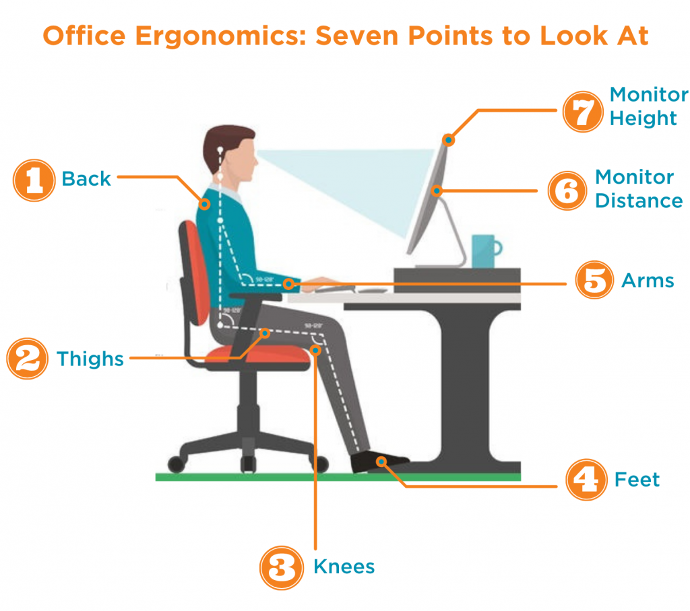
Back
Your back should be in full contact with the back of the chair. Yes, that does mean you have to sit all the way back in the seat. No perching on the front edge of your seat! (Do as we say, not as we do.) The chair’s lumbar support should sit in the natural curve of your back. This helps lift your posture and takes pressure off your lower back.
Hips and Thighs
Your thighs should be approximately parallel to the floor. This ensures proper circulation in your legs. Your hips should be slightly higher or even with your thighs—about a 95- to 110-degree angle. Your hips should never be lower than your legs.
Knees
When you’re sitting with your back against the back of the chair, there should be only one to two inches of space between the front of the seat and the back of your knees. Anything more than that will allow your knees to droop and cut off circulation to your legs and feet.
Feet
Once all of the other adjustments have been made (your knees are at the right angle, your arms rest comfortably at the right height, and your eyes meet your monitor at the correct angle), your feet should sit flat on the floor.
Arms
Your arms should rest comfortably on the arm rests. When you use your keyboard, your arms should be at a 90-degree angle or even slightly downward. (Yes. That does mean that you shouldn’t be using those little feet on the bottom of your keyboard.) This will help reduce shoulder and neck strain.
Monitor Distance and Monitor Height
When you’re seated comfortably in your chair and pulled up to your desk, your monitor should be about an arm’s length (18” to 22”) away from your body. If it’s any farther away than that, your eyes may have to strain to read easily. The top third of your monitor should be at or slightly below eye level. This will keep your neck in proper alignment for comfort.